
Hot Composting
Using a hot process to make much better compost in a lot less time
Hi everyone,
In this post, I want to cover a few other things (in addition to RECIPE) that are essential to making high quality compost as efficiently as possible: HEAT, AIR and TIME
As I mentioned in my last post, if you throw a bunch of food scraps or leaves or both into the woods…they will eventually break down. This is what we’ll call a cold or unmanaged composting process.
Hot composting, however, is a managed process in which you harness the natural ability of microorganisms to use AIR and the nutrients in your RECIPE to generate HEAT. You turn the pile as it reaches certain temperatures and then leave it sit for different periods of TIME…then turn, and wait and turn some more…and some more…
Hot composting has some important benefits as it:
Takes a lot less time to make
Kills weed seeds
Kills plant and human pathogens.
Commercial compost operators are required to use a hot composting process. Of course, nobody in business wants to sell compost that infects their customer’s garden with disease or unwanted weeds. They also don’t want to wait for years to sell their product.
Backyard composters, on the other hand, have more flexibility. If you can’t manage your pile by turning it on a regular basis, it’s not the end of the world. You can always let it sit longer (like a lot longer) and it will become usable compost.
But, if you can turn it regularly, you will be rewarded with high quality compost without weed seeds or pathogens within 6-7 months.
So, here’s what you need if you want to hot compost:
AIR
We want to encourage aerobic microorganisms (ones that need air) in compost piles and bins. Not only do they break down the organic materials, they also outcompete the pathogenic microorganisms that are mostly anaerobic. So, in addition to food and drink we need to make sure the microorganisms have access to oxygen.
AIR flows both passively and actively through a pile of compost. Passive airflow happens naturally. Cooler air in the outer layers of the pile moves towards the warmer middle of the pile and flows upwards through the top of the pile.
As air flows around the decomposing materials, bulky materials keep the pile more porous, allowing oxygen to reach the aerobic microorganisms. Wood chips with their varying particle size are a great choice for adding bulk to your compost RECIPE.
Active air flow happens when you turn your pile, which is essential to keeping the pile aerated.
As you begin a batch of compost, you want to mix up all the materials with a good turn. This is a first step to encouraging those aerobic bacteria by providing plenty of AIR throughout the pile.
HEAT AND TIME
Turning will also ensure your moist, nitrogen rich food scraps are well integrated with the carbon rich and bulky materials. HEAT is generated by microorganisms in your compost pile as they metabolize this balanced RECIPE you’ve given them.
ACTIVE PHASE - first two to four months
Now that your compost is thoroughly mixed, all you need to do is sit back and wait for the microbes to do their work. After a few days, the pile should start to heat up. If you poke into it with a stick or pitch fork, you might see steam rising up. That’s a good sign.
If you want to get serious about composting, buy a compost thermometer. They’re not expensive (cheaper ones can be found online or at your local farm store for $20-$25). Select one that has a probe long enough to poke into the middle of your pile. A probe around two feet long is usually sufficient for the backyard compost pile or bin.
Some interesting things are going on inside the pile as it heats up. The microorganisms are certainly having a grand time, eating and drinking and reproducing. But as their little bash heats up, the guest list starts changing.
At around 112 °F Mesophilic bacteria (those with an affinity for moderate temperatures - derived from the Greek to mean “middle loving”), are being replaced by thermophilic “heat loving” bacteria.
As these thermophilic bacteria dominate the pile, they grow and generate more heat, which helps them grow and thrive even more.
Make sure your pile heats up to at least 131 °F, and stays at that temperature for at least three days, if you want to kill human and plant pathogens. If you do that, you can actually compost meat which has more potential to harbor human pathogens (e.g. salmonella) than other kinds of food scraps.
Your compost microorganisms are at their rowdiest at these higher temperatures. Just leave them to their wild ways. Then, after at least three days (making sure with your thermometer that the temperature stays at or above 131 °F the whole time), turn the pile. You can let it sit a few days more before turning, but don’t let it go too high. Turning it around 140 °F or a little higher is best.
Turning will provide fresh air, even out the moisture and expose raw feedstocks. It will also redistribute the pile so that material that was on the cooler edges is now in the middle where it will be exposed to higher temperatures.
The temperature of the pile drops quickly after a turn, as the microorganisms begin feasting away on raw feedstocks again. It will likely take them several days at least to finish off the food and drink you just gave them.
If you poke your thermometer into the pile in a day or so, you should see the temperature rise again.
Once it reaches 131 °F leave it for three more days (making sure it stays above that level) then turn it again.
Repeat this cycle until the temperature stops rising up to or over 131 °F. This may involve at least a handful of turns over the first few months.
I know, that’s a lot of turning! But after the initial few weeks of pretty intensive turning, the growth of the microorganisms starts to slow down, it takes longer for the pile to reach 131 °F, and you need to turn less. So, it gets easier as you go along.
FINISHING PHASE - three to six months after active phase is complete
If you can’t see any discernible raw materials (definitely no gooey food scraps!), and the stuff is smelling better, more like a forest floor with maybe a hint of ammonia or even a whiff of what might be described as musky (think pipe tobacco), you know you’re getting somewhere.
Your pile is now moving out of the active phase into the finishing phase.
Bacteria are still present but the thermophilic bacteria are being replaced by a new type of mesophilic bacteria (actinomycetes). These little guys are really good at digesting the tougher materials like wood chips and bits of bark. This new mesophilic party scene is still eating and drinking, growing and reproducing though at an even slower, more relaxed pace.
In addition, other microorganisms (including fungi, protozoa, nematodes and microscopic animals) are starting to appear. All that is good news for your compost pile as diversity is a sign of a healthy microecosystem in maturing compost.
More good news is that turning your compost every other month or so is fine.
At the end of the finishing phase, your compost should be dark brown and crumbly in texture with no recognizable pieces of raw material save for the occasional larger chunk of wood or bark. Your compost should now just have a nice earthy smell. You might see lots of worms show up particularly on the cooler edges of the pile.
Go ahead and use it whenever you want.
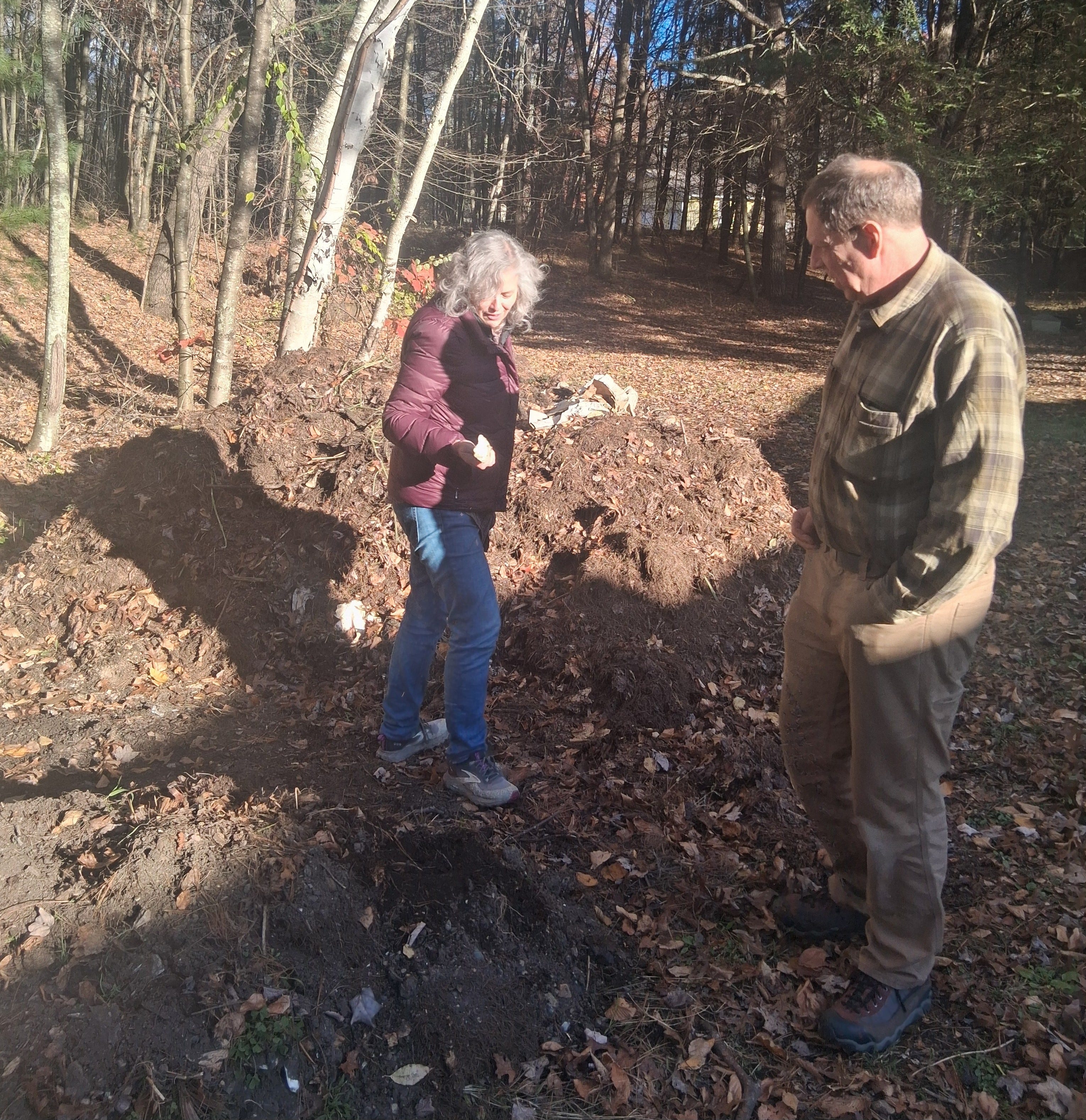
Andrew Mankin and Nancy Dutton pick out overs from their backyard compost pile.
As you load it up into the wheelbarrow to put it into your garden, that’s a good time to pick out what compost operators call the “overs”. Those are the really hard to digest pieces like corn cobs, bits of bark, larger wood chips. Add them to your next batch of compost as they are a great way to add bulk to that soon-to-be active pile.
In next week’s post, we’ll explore the pros and cons of different composting systems (piles, bins, tumblers) so you can build or buy the one that suits your needs and budget.
Have a great week!